|
|
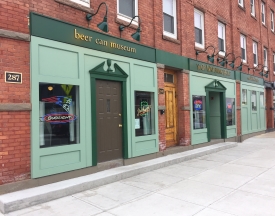
History of the Beer Can Museum
The Legend
In 1942, five young friends
about to serve in World War II came into the current location at
287 Pleasant Street for a farewell toast. Each of them placed a full
can of beer on the wall, with a vow that they would all return
and toast those cans upon their return from duty. Only three
of the five men came home.
The remaining three drank the beers they had
left on the wall, and placed
the three empty cans next to the two full
ones in memory of their comrades.
The
Museum
In 1975, former
owner and collector Al Drew decided to put on display his sizeable
beer can collection within the bar, and his original setup of the can
shelves, (especially the ones suspended from the ceilings in the pool
room), remains the same today as it was when the museum began.
There are more than 4,000 cans on display that
are an interesting and historic wallpaper of this
legendary local bar.
In 1989, the Ye Ol' Watering Hole and its can collection
was sold to Gary Kelly, and, subsequently, in 1992, to its current owners,
Jim and Colleen McGorry.
Restoration
Over
the years, heavy second hand smoke took its toll on many
cans, and the collection became somewhat of an eyesore
due to its deteriorated condition. A statewide ban on smoking
in bars in 2004 helped change that. Thanks to the efforts of numerous
people, especially our good friend (and serious collector) Bob (Hubie)
Huber, and the countless people that have donated cans over the
years, the bar and the collection has been substantially
upgraded . It truly is a piece of American beer
history!
A Brief History of the Beer
Can
1935: The first steel beer cans were
introduced in Virginia by the Gottfried Krueger
Brewing Co. The larger
brewers were quite skeptical of the can, so the can
manufacturers
started their marketing strategy with the smaller, local brewers in
hopes of showing the can's success to the large brewers across the
country.
The Watering Hole collection of cans manufactured from
1936-1960 are on
display upon entering the Pool Room on the upper
shelves at the front of the bar.
Although many of these cans are
not in the best of shape,
they sure are interesting to look
at!
Advantages of can vs. bottle:
Half the height and weight of
bottles
Easily stackable
Less packaging required
Reduced shipping
costs
1940 Can manufacturers created the
"cone-top" and "crowntainer" cans instead
of flat-tops. These cans
could be filled by the same machines that filled bottles, and
capped in
a similar fashion. However, the cone-top and crowntainer
ultimately
could not compete with the popularity and cost-effectiveness
of the flat-top cans,
and their production ceased by the late
1950s.
Cone-tops and Crowntainers in the Watering Hole collection
are on display
in the same section as the flat-tops in the Pool
Room.
1960 Aluminum "tab-tops" were
introduced. Cheaper to produce, lighter in weight,
and easier to open,
they caused the decline and elimination of the steel can by
the mid
1960s.
1975 By this time, tab-tops were
becoming an ecological problem. The removal
and disposal of the tab
after opening created a great deal of hazards and waste,
thus, the
creation of the pop-top can currently in use.
The invention of the
pop-top rendered the tab-top obsolete by the early 1980s.
Miscellaneous Facts:
Oldest
can in the collection: Currently undetermined, but the
majority of the steel
flat-top and cone-top cans date back to
1935-1960. Catalogue-ing of these steel
cans is currently in progress,
to be followed by pull-tab cans, and finally the
pop-top cans of
today.
Most requested can: Billy
Beer. Created by President Jimmy Carter's Brother in
1976, this can is
nostalgic and always requested. However, the can itself is not worth much
due to the enormous amount available in circulation.
The two Billy Beer
cans on display at the Watering Hole are in the
section to the left
immediately after entering the bar side door.
Most valuable can: Also
undetermined. However, the large quart "Oil Cans",
a 16 oz rare Krueger
can, and some other assorted 16 oz flat-tops are considered
some of the
best in our collection.
The large cans behind the bar are mostly
European imports, and more for
show than value, with the exception of a
few of the American gallon cans.
Can
Collecting
As a general rule, the Watering Hole does not
actively buy, sell, or trade cans.
However, we are always interested in
donations of cans or any beer-related items.
For those of you
interested in getting involved in Beer Can Collecting, contact the
B.C.C.A. (Beer Can Collectibles of
America)
Open: 3:00 PM to 1 AM (2 AM on Fri. and
Sat.)
Remember, you must have a valid 21+ ID to
enter the premises.
|